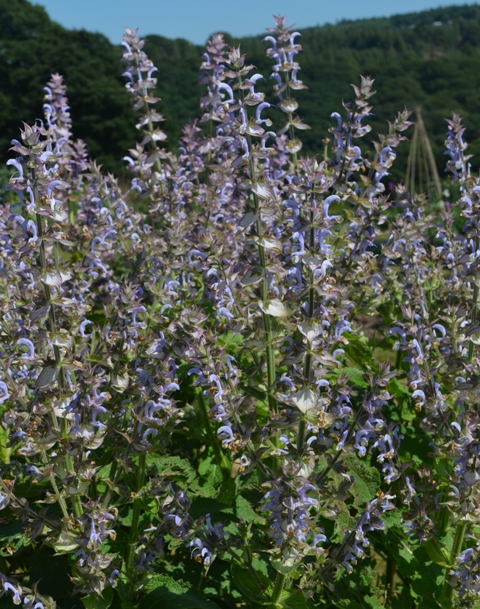


The medicinal properties of Clary sage was mentioned by Pliny the Elder, AD 23–79 during the early Roman Empire. Today it is cultivated for the production of essential oil. Culpepper, a famous 17th Century herbalist, refers to it in his Complete Herbal (1653) as “clear-eye”. The plant is biennial. The leaves are large, grey green and hairy. In the second year it can reach a height of 1 meter with numerous large flowers of pale mauve. The flowers are very spectacular. They are arranged in whorls along the flower stem arranged above the colourful bracts. Salvias like sage and clary sage belong to the mint family, Labiatae like many other aromatic herbs such as rosemary, basil, thyme and lavender. The flowers all have a similar form where the petals are fused into an upper and lower lip. The lower lip is designed as a landing platform for bees while the upper lip holds the stamen and pollen which is deposited onto the bees back and then transported to the next flower for pollination. The plant fragrance is very complex and is used in perfumes and to flavour ale and wine. Not to be confused with clary bouquet, Salvia hormonium, which is a smaller annual with multi-coloured bracts.
How to grow:
Sow seed in March and April in seed trays of good organic compost. Prick out into 8cm pots when large enough to handle and grow on. Transplant into the growing site in May in a free draining, sunny site. Plants will grow a bit in the first year but they will put on most growth in the second year when they flower.
Pests and diseases:
Clary sage does not suffer from any particular diseases but they are very attractive to slugs and you may need to give them some protection.
How to use:
The essential oil is distilled from the leaves and flowers. It is soothing and can aid sleep, however we just grow it for the aesthetics of the plant in flower.